Knowledge retrieval
Prepare source documents, define access boundaries and return answers with supporting references. Evaluate unsupported questions and outdated or contradictory material.

AI services
Connect repetitive checks, approvals and follow-ups into a reviewable business workflow.
Connect repetitive checks, approvals and follow-ups into a reviewable business workflow.
The work, in detail
Purchasing, finance and warehouse owners need a system that fits the information, permissions and responsibilities already present in their work.
Review the current process, representative examples and integration dependencies before selecting a solution approach.
Keep the relationship between input, output and action visible. Evaluate ordinary examples and exceptions with the people responsible for the result.
What takes shape
Final scope is agreed after discovery. These are the working outputs we can shape around your context.
Prepare source documents, define access boundaries and return answers with supporting references. Evaluate unsupported questions and outdated or contradictory material.
Define what the agent may read, draft and change. Use constrained tools, explicit approvals, timeouts and a recoverable record of each attempted action.
Break a larger task into reviewable steps with typed handoffs and named owners. Test partial failures, repeated events and escalation before a workflow runs unattended.
A connected delivery path
Establish the source records and the intended result. For AI Automation Systems, confirm the input quality and permission boundaries before processing.
Connect the approved sources and apply the task-specific checks. Keep missing information and uncertain results visible for review.
Review representative outputs and exceptions with the accountable owner. Agree what may proceed and what requires correction or escalation.
Record the outcome, hand work to the responsible team and retain the information needed to investigate or improve the next run.
Prepare for a useful conversation
Prepare approved source material and representative questions and tasks. Start with approved or synthetic examples and identify gaps before introducing live records.
Involve ai product owners, knowledge teams and application engineers. Identify who can confirm the workflow, review an exception and accept a release.
Define how you will assess task completion on representative examples. Record the current process and include difficult cases in the review set.
Applied AI and knowledge systems
Choose a bounded job before choosing a model. Connect approved knowledge, explicit tool permissions and a representative evaluation set so the team can judge the system before widening access.
Prepare source documents, define access boundaries and return answers with supporting references. Evaluate unsupported questions and outdated or contradictory material.
Define what the agent may read, draft and change. Use constrained tools, explicit approvals, timeouts and a recoverable record of each attempted action.
Break a larger task into reviewable steps with typed handoffs and named owners. Test partial failures, repeated events and escalation before a workflow runs unattended.
Define success before delivery
Choose a representative sample, record the current baseline and agree who accepts the result. These are evaluation criteria to discuss, rather than promised outcomes.
Task completion on representative examples
Grounding, citation quality and unsupported-answer rate
Latency, cost, permissions and recovery behaviour
A model response is not evidence that an external action completed. Check tool results, protect restricted data and route uncertain or consequential decisions to a person.
Inside AI Automation Systems
Approved source material
Integration scope to confirm
Outputs to agree in discovery
From the project library
Explore the product patterns and operating context relevant to ai automation systems. Each profile explains its own scope and stage; adjacent examples do not imply the same solution has already been delivered.
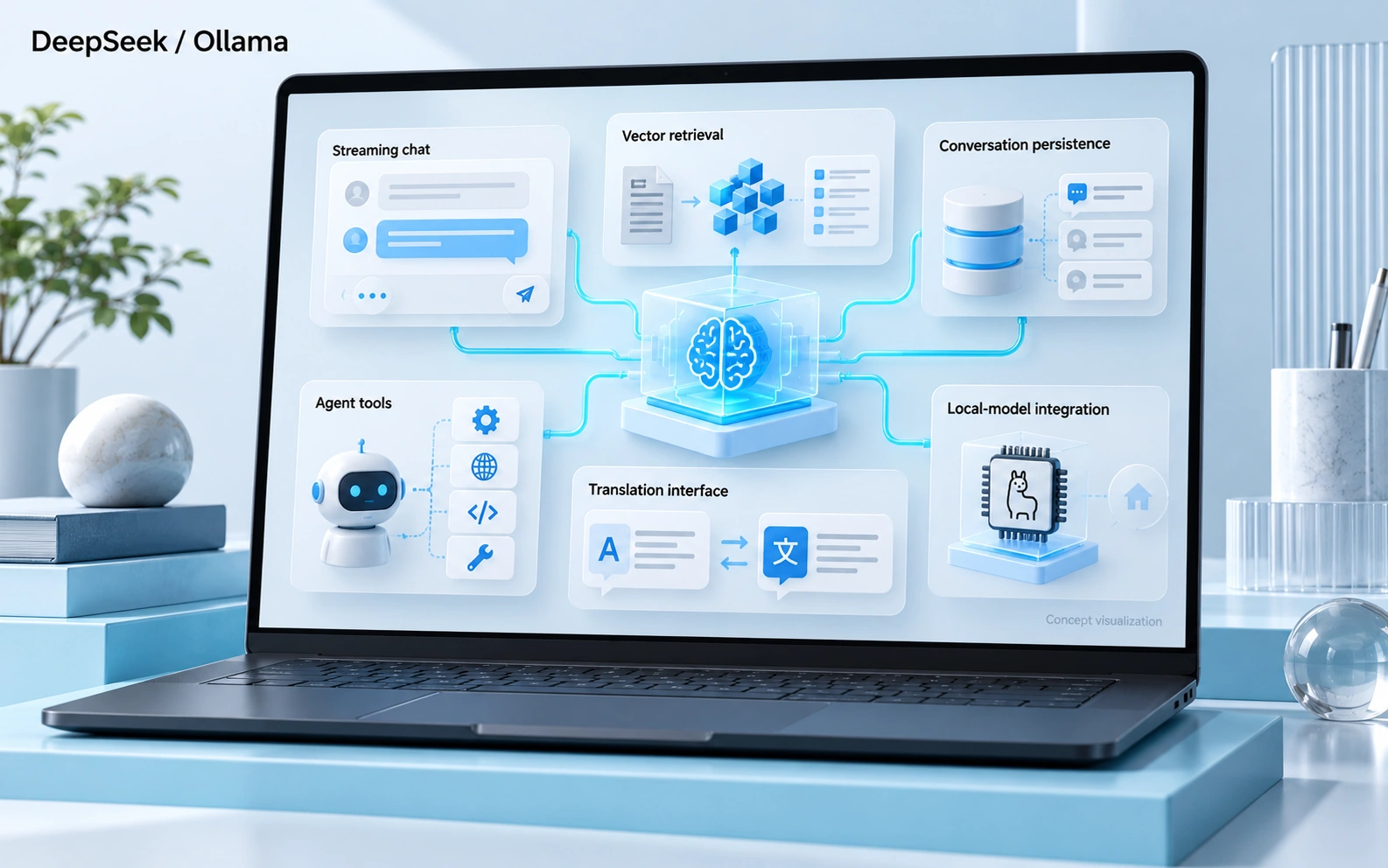
Application · AI concept visualization · project scope
A full-stack chat application combines streamed responses, retrieval, stored conversations and configurable agent tools.
Teams need conversational access to selected documents and model services rather than manually searching each source.
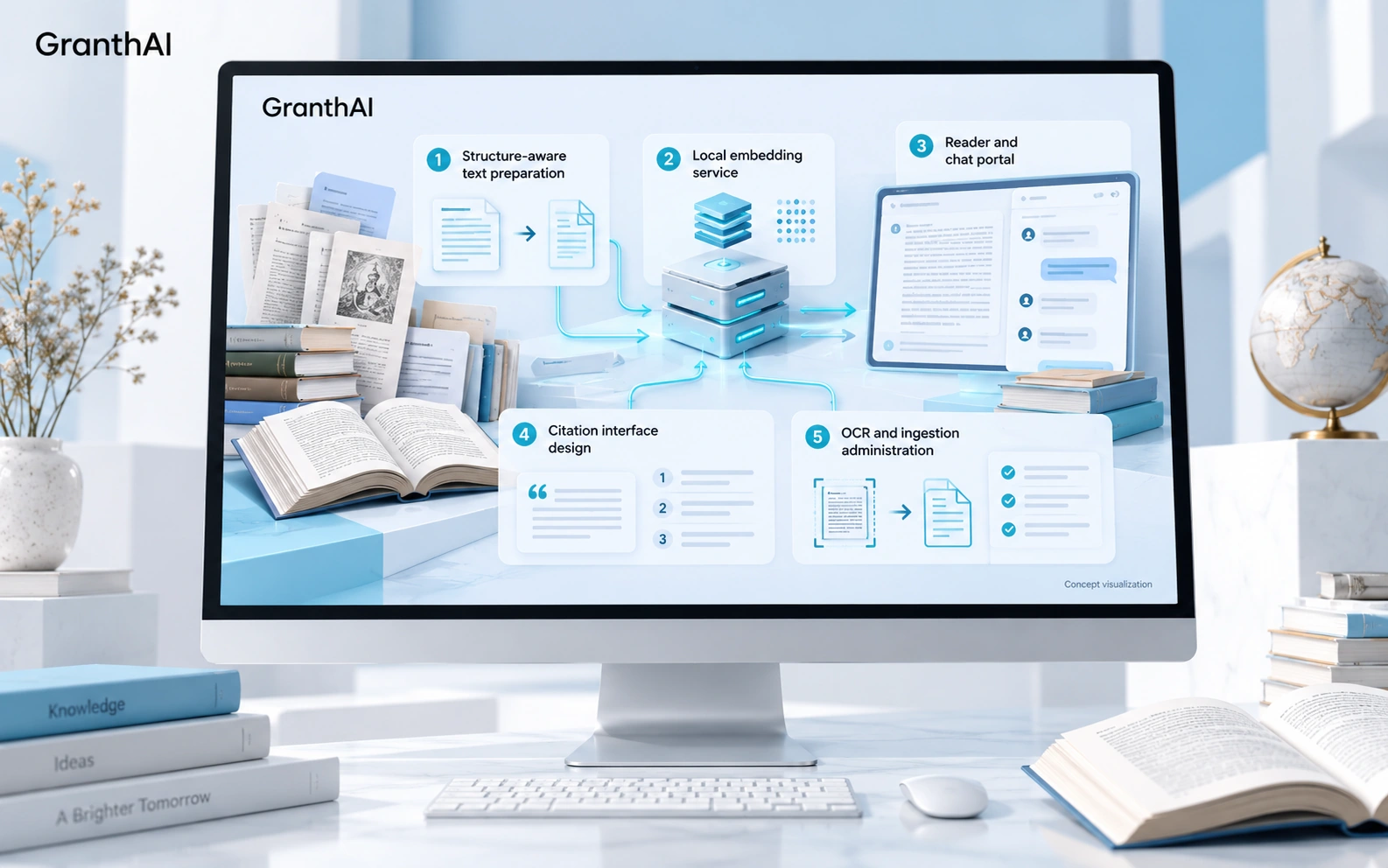
Prototype · AI concept visualization · project scope
Document preparation and local embeddings support a planned reader/chat portal, while administration screens cover ingestion and quality review.
Readers need to search multilingual books without losing the relationship between original passages and their explanations.

Framework · AI concept visualization · project scope
A modular framework links speech detection, transcription, response generation, speech synthesis and avatar rendering through interchangeable handlers.
Voice, language-model and avatar components are difficult to assemble into a coherent real-time conversation pipeline.
Project profiles describe their available scope and development stage. Interface captures, documentation and workflow concepts are labelled separately; they are not claims of measured business results.
Before we begin
Bring approved source material, representative questions and tasks, role and tool-access boundaries, evaluation examples and review criteria. Include a person who knows the current process and can explain the difficult cases. An outline or synthetic example is sufficient for the first conversation.
Agree one bounded journey during discovery. A possible first output is source-grounded assistant workflows, supported by a clear review owner and acceptance examples. Constrained tool and agent integrations and Evaluation and operating handover materials can be scoped where the operating case supports them.
We first review the available interfaces and access rules for approved model and retrieval interfaces, knowledge and document stores, identity systems and task-scoped business apis. An initial engagement can use approved exports where a direct integration is unavailable. Live updates require an agreed permission model and recovery path.
Agree examples, failure cases and acceptance criteria before the build. Review source traceability, correction effort, access boundaries and the handover into everyday operations. We do not promise a fixed saving or performance figure before that assessment.