
DeepTech, IoT & Embedded Engineering
Connect physical systems and software through edge intelligence, industrial IoT and embedded engineering.
Built around your operating context
Device engineers, product owners and operations specialists
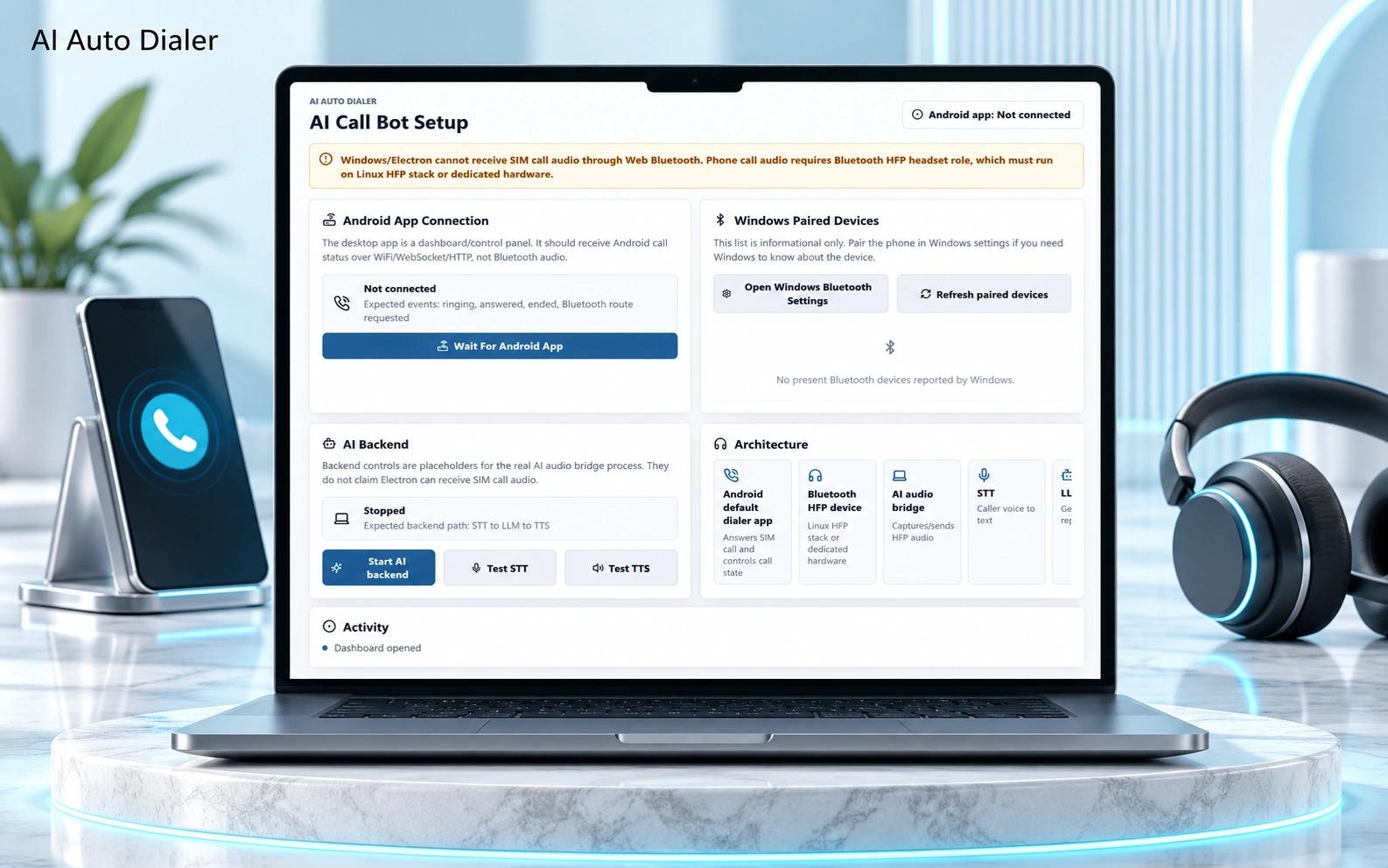
MVP · AI presentation artwork · screen reference
AI Auto Dialer
Android call-answering interface · Bluetooth routing request · Desktop device dashboard
Connected devices and physical systems
Connect the physical signal to a useful response.
Signals and interfaces
Identify the sensor, protocol, sampling needs and expected failures.
Explore the approach
Identify the sensor, protocol, sampling needs and expected failures. Check timestamp quality, missing readings and how an operator recognises a disconnected device.
Edge and cloud responsibilities
Choose where processing belongs based on latency, connectivity, privacy and device limits.
Explore the approach
Choose where processing belongs based on latency, connectivity, privacy and device limits. Define buffering and synchronisation when the network is unavailable.
Field validation
Test the complete chain in representative operating conditions.
Explore the approach
Test the complete chain in representative operating conditions. Include calibration, device updates, replacement and access control in the handover.
Choose what your project needs
A clear scope.
A useful result.
Our approach
Begin with device constraints, telemetry needs and field conditions. Test the hardware-to-cloud path before scaling deployment.
DeepTech & industrial intelligence
Assess the physical process, available sensor signals and on-site constraints before choosing the technology. Validate edge inference and connected-asset models with representative operating conditions.
Edge AI & Computer Vision
Assess inference needs, compute limits, latency and on-site connectivity. Validate models on representative devices and operational conditions before wider deployment.
Industrial IoT & Sensor Integration
Connect approved sensors and device interfaces to usable operating records. Agree units, timestamps, data ownership and behaviour when a device is offline.
Digital Twins & Asset Monitoring
Represent the asset state needed for a specific operating decision. Define how the model is updated, what is inferred and what an operator must verify.
Embedded and connected product work
Select technologies according to the product constraints, integration requirements and the team that will maintain the system.
New Product Designing
Translate a product use case into device, interface and software requirements. Test the riskiest assumptions before committing to a wider implementation.
Embedded Firmware Planning
Define device behaviour, interfaces, update strategy and failure handling. Agree hardware constraints and field verification requirements with the product team.
Device Telemetry
Structure readings and device events so they can be interpreted consistently. Design for missing values, delayed messages and traceability back to the source.
IoT Dashboards
Give operators a focused view of device state, history and exceptions. Tie alerts to a responsible person and a documented response path.
Field Monitoring
Review device behaviour in realistic operating environments. Define connectivity expectations, event collection and the support information needed to investigate problems.
Predictive Maintenance
Use condition signals and maintenance history to support planner investigation. Compare alerts with known events and track missed signals and false alarms.
From first release to ongoing improvement
Agree acceptance criteria, test the critical user journeys and document the release and support path.
In project context
The work behind the possibilities.
AI presentation artwork · screen reference
Telephony · MVP
AI Auto Dialer
Android call-answering interface · Bluetooth routing request · Desktop device dashboard

AI concept visualization · project scope
Procurement · Prototype
ProcureOS AI
Command-center intake · ERP-context fixtures · Vendor shortlisting
Each project has its own scope and stage. Explore the profile for implementation details.
The path from idea to operation
Start focused.
Build with clarity.
- 01
Sense
- 02
Connect
- 03
Interpret
- 04
Respond
Deliverables & evaluation
What takes shape
Validated device-to-service interfaces
Identify the sensor, protocol, sampling needs and expected failures. Check timestamp quality, missing readings and how an operator recognises a disconnected device.
Edge and cloud responsibility maps
Choose where processing belongs based on latency, connectivity, privacy and device limits. Define buffering and synchronisation when the network is unavailable.
Field-test and maintenance handover plans
Test the complete chain in representative operating conditions. Include calibration, device updates, replacement and access control in the handover.
Know what good looks like
- Signal completeness and interface reliability
- Latency and behaviour under connectivity loss
- Maintainability, update recovery and operator usability
Current portfolio examples show adjacent device and operations patterns, not a certified embedded-hardware or industrial-control deployment. Hardware validation and safety obligations require a separately agreed scope.
Bring the context. We’ll shape the next step.
From your world.
Into a working plan.
Source material
- Sensor and protocol specifications
- Sampling and latency requirements
- Connectivity and power constraints
- Field conditions and operator responsibilities
Systems to connect
- Agreed device and gateway protocols
- Edge processing and connectivity services
- Approved operational data interfaces
Useful outputs
- Validated device-to-service interfaces
- Edge and cloud responsibility maps
- Field-test and maintenance handover plans
Readiness checklist
Representative source material
Prepare sensor and protocol specifications and sampling and latency requirements. Start with approved or synthetic examples and identify gaps before introducing live records.
The right people in the room
Involve device engineers, product owners and operations specialists. Identify who can confirm the workflow, review an exception and accept a release.
An agreed evaluation baseline
Define how you will assess signal completeness and interface reliability. Record the current process and include difficult cases in the review set.
Good questions.
Clear answers.
What should we bring to a first conversation?
Bring sensor and protocol specifications, sampling and latency requirements, connectivity and power constraints, field conditions and operator responsibilities. Include a person who knows the current process and can explain the difficult cases. An outline or synthetic example is sufficient for the first conversation.
What would the first release include?
Agree one bounded journey during discovery. A possible first output is validated device-to-service interfaces, supported by a clear review owner and acceptance examples. Edge and cloud responsibility maps and Field-test and maintenance handover plans can be scoped where the operating case supports them.
Can this work with our existing systems?
We first review the available interfaces and access rules for agreed device and gateway protocols, edge processing and connectivity services, approved operational data interfaces. An initial engagement can use approved exports where a direct integration is unavailable. Live updates require an agreed permission model and recovery path.
The next useful step